Why finance and IT teams need to rethink the subledger vs general ledger boundary — and a practical framework for getting it right.
In my work helping organisations implement finance solutions across sectors like government licensing and registration, health and aged care, superannuation, and circular economy, I've noticed a recurring challenge: finance and IT teams don't always understand where transaction detail should live — and it doesn't get sorted until reporting and reconciliation problems emerge.
The conversation usually starts something like this:
"We want to see real-time debtor balances in Oracle."
"Why can't I drill into individual client transactions in D365?"
"We need all our claims data visible in the finance system."
"We want to send a single invoice to a client receiving multiple services across different brands."
"This is how we've always done it."
These are reasonable requests. But in high-volume transactional businesses, fulfilling them literally — by pumping every transaction into the General Ledger — often means the operational system's subledger capability is underutilised, and finance teams end up managing transaction detail across multiple places — with reconciliation headaches as the inevitable result.
This article introduces a practical framework for thinking about finance architecture, and offers guidance on when to rely on your operational systems for transaction detail versus when to expect that detail in your core finance platform.
The Finance Management Framework
To help clients navigate these decisions, I use a four-layer model that describes how business transactions flow through to financial reporting:
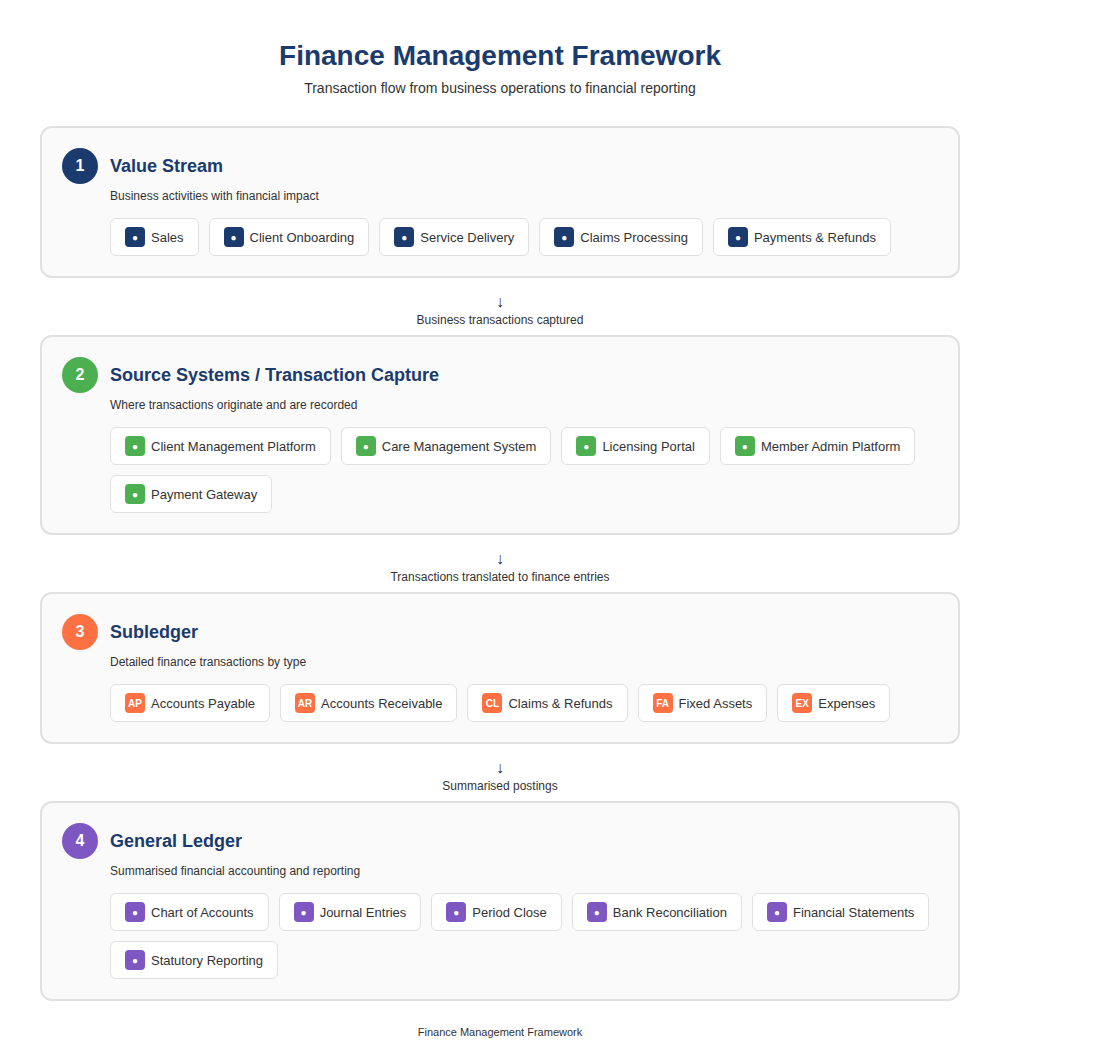
The Four Layers
| Layer | Description |
|---|---|
| Value Stream | The business activities that generate transactions with financial impact — client admissions, container refunds, licence renewals, claims processing |
| Source Systems / Transaction Capture | Where transactions originate and are recorded — care management platforms, POS systems, licensing portals, claims engines |
| Subledger | Detailed finance transactions organised by type — Accounts Payable, Accounts Receivable, Claims & Refunds, Fixed Assets. This is where individual debits and credits against client/supplier accounts are recorded |
| General Ledger | Summarised financial accounting — Chart of Accounts, Journal Entries, Period Close, Financial Statements, Statutory Reporting |
The critical insight is that each layer serves a different purpose, and expecting your General Ledger to do the job of a Subledger (or vice versa) leads to trouble.
The "Thin" vs "Thick" General Ledger
Oracle's documentation articulates this well with the concept of "thin" versus "thick" General Ledgers:
- A thin GL contains minimal operational detail — only the high-level accounts and balances needed for financial control and statutory reporting. Daily transactions are summarised before posting.
- A thick GL attempts to capture every transaction in detail, with many account segments, frequent postings, and large datasets to support operational analytics directly.
Most enterprises find that a thin GL is the right choice for high-volume environments. As Oracle notes, "the more journals and detailed balances in the GL, the greater the demand on storage and system resources."
The principle: Use the right tool for the right level of detail. The General Ledger is intended for consolidated financial control and reporting — not for transaction processing or operational analytics.
Where Should the Subledger Live?
Here's where it gets interesting. In many high-volume transactional businesses, the subledger doesn't live in the core finance platform at all. It lives in the operational system.
Consider these examples:
Government Licensing and Registration
A state licensing authority might issue hundreds of thousands of permits, registrations, and renewals annually. Each transaction — application fee, renewal payment, penalty, refund — is recorded in the licensing platform.
The licensing system maintains the detailed account for each licence holder. It tracks payment history, outstanding balances, and transaction adjustments. When a licence holder queries their account, staff look in the licensing system — not the GL.
The GL receives periodic summaries — total revenue by licence type, total outstanding fees, total refunds processed. That's enough for financial reporting and statutory requirements.
Member and Client Account Businesses
Organisations that manage ongoing client or member relationships — aged care providers, superannuation funds, insurers, membership bodies — often process thousands of daily transactions: fees, contributions, claims, adjustments, government funding.
These transactions originate in the client management platform. The platform maintains detailed member or client accounts, tracks entitlements, manages billing cycles, and handles complex business rules around claims and adjustments.
Does all this detail need to flow into Oracle or D365?
In most cases, no. The platform acts as the subledger for client accounts. It holds the transaction-level detail — every charge, every adjustment, every payment. The GL receives summarised journals — total revenue by category, total receivables by type — on a periodic basis.
The Pattern
| Layer | System | Detail Level |
|---|---|---|
| Source System | Licensing portal / Client management platform | Individual transactions |
| Subledger | Same operational system | Client/account-level balances and transaction history |
| General Ledger | Core finance platform (Oracle / SAP / D365) | Summarised journals by category |
The operational system is the subledger. The GL receives summaries.
"But We Want to See Everything in One System"
This is the most common objection I hear from finance teams. And it's understandable — nobody wants to juggle multiple systems to answer a simple question about a debtor balance.
But let's examine what happens when you try to replicate high-volume transaction detail into the GL.
The Anti-Pattern: Treating the GL as a Big Data Store
Industry experts consistently warn against this approach. Aptitude Software, a specialist in accounting hubs, puts it bluntly: "Traditional GLs were not designed to handle the sheer volume and granularity of today's transactional data."
What goes wrong:
- Performance problems — Millions of journal entries slow down posting, querying, and period close. Running a trial balance becomes painful. Month-end close extends from days to weeks.
- Complexity and maintenance overhead — A thick GL requires a complex chart of accounts with many segments to capture operational dimensions. Every business change (new service line, new region, re-org) requires chart of accounts modifications.
- Reconciliation nightmares — Ironically, duplicating data into the GL doesn't eliminate reconciliation work — it makes it worse. Leapfin, a finance automation firm, reports that "up to 50% of Accounting's time is spent chasing down reconciliation issues" when transaction detail is replicated across systems.
- Loss of data lineage — When multiple systems feed the GL independently, it becomes difficult to trace balances back to source transactions. Auditors struggle. Compliance risk increases.
The Legacy Migration Trap
When organisations migrate from legacy finance platforms to modern ones, there's a tendency to replicate existing patterns — even when those patterns no longer make sense. New operational systems often come with subledger capability that gets ignored because "that's not where the subledger has always been." The finance platform migration becomes a like-for-like lift, carrying forward architectural decisions that were made for a different era.
This is a missed opportunity. A platform migration is the perfect time to ask: "Should the subledger still live in the core finance platform, or should we let the operational systems do what they're designed to do?"
The Reality: Finance Teams Already Use Multiple Systems
Here's the thing: finance teams already look at multiple systems. They pull data into Excel. They run reports from operational dashboards. They query data warehouses. They run automation tools and bots to log into systems and download invoices.
The question isn't whether to use one system or many — it's which system is authoritative for which level of detail.
A well-designed architecture makes this clear:
- For individual transaction detail: Go to the operational system / subledger
- For consolidated financial position: Go to the General Ledger
- For analytics and trending: Go to the data warehouse
The operational system isn't a workaround — it's the right place for transaction-level queries.
The Chart of Accounts Question
There's a downstream consequence to this architectural decision that's easy to overlook: your Chart of Accounts design.
Dimensions and the Thick GL Trap
A General Ledger typically uses a multi-segment account structure — often called dimensions or segments. Common dimensions include:
- Account (revenue, expense, asset, liability)
- Cost Centre (department, team, location)
- Fund or Program (funding stream, grant, project)
- Service Line (product, service category)
When organisations push transaction detail into the GL, they often need more dimensions to support operational reporting. "We need to see revenue by facility, by funding type, by client category, by service stream..." — and suddenly you have a six or eight-segment CoA trying to capture operational reality.
This is the thick GL trap.
Why Dimension Changes Are Painful
The problem isn't just complexity — it's coupling your finance system to your operating model.
When you bake operational dimensions into your GL structure:
- Every business change becomes a CoA change — new service line? New cost centre structure. Restructure? Remap everything. Acquisition? Good luck.
- Historical comparability breaks — change your dimensions and you can't easily compare this year to last year without remapping.
- Integrations need updating — every system that posts journals needs to know the new structure.
- Reports need rewriting — every report that slices by those dimensions.
- Governance overhead — who approves new dimension values? Who maintains the hierarchy? Who ensures consistency?
I've seen organisations spend months — sometimes years — on CoA restructure projects — not because the GL system is hard to change, but because everything connected to it needs to change too.
The Alternative: Keep Dimensions in the Subledger
If operational dimensions live in the source system (care platform, scheme system, licensing portal), then:
- The GL stays stable — a lean CoA focused on financial control
- Operational reporting happens in the operational system, where it belongs
- Business changes don't drag the whole finance architecture with them
Your GL might have simple dimensions: Account, Cost Centre, Fund. That's enough for statutory reporting and financial control. The operational system handles the rest.
This doesn't mean you lose analytical capability — it means you put it in the right place. A data warehouse can pull from both systems if you need consolidated operational analytics.
When Does Subledger-in-Operational-System Make Sense?
This approach works well when:
- High transaction volumes — Thousands or millions of transactions per day/month
- Domain-specific business rules — Claims validation, funding calculations, care assessments, scheme-specific logic
- Operational staff need real-time visibility — Care coordinators, claims processors, customer service need to see current balances
- Regulatory requirements at transaction level — Audit trails, funding acquittals, compliance reporting tied to individual transactions
When to Push Detail to Core Finance
The subledger-in-finance-platform approach makes more sense when:
- Low transaction volumes — Hundreds rather than millions
- Finance team is primary user — No operational staff querying individual transactions
- No domain-specific operational system — The finance platform is the only system in play
- Tight integration with standard AP/AR workflows — Invoice processing, payment runs, credit management all handled in the finance platform
Integration Patterns: Getting Data from Operations to the GL
Once you accept that the subledger lives in the operational system, the next question is: how do summarised journals get to the GL?
Common patterns include:
Batch File Transfers
Scheduled jobs extract transactions from source systems, transform them into journal entries, and load them into the GL in bulk — daily, weekly, or per billing cycle.
Example: A government transport agency batch-posts millions of daily toll transactions as a single summarised journal per toll plaza per day.
API-Based Integration
Event-driven updates push accounting entries throughout the day. Transactions are typically still aggregated to avoid overwhelming the finance platform.
Example: A banking system publishes account debit/credit events to an accounting API, with near-immediate GL posting for critical accounts.
Accounting Hubs
A dedicated integration layer sits between operational systems and the GL. It ingests detailed transactions, applies standardised accounting rules, and generates summarised journal entries.
This can be a vendor product — like Oracle's Accounting Hub — or something you build yourself on your integration platform. The key is having a single point where transactions are transformed into GL-ready entries with a full audit trail. Gartner refers to these as "Accounting Engines".
The "Two Systems" Question
So, is it really a problem that finance teams need to look at two systems — the operational platform for transaction detail, and the core finance platform for consolidated financials?
My view: No, it's not a problem. It's the right architecture.
The alternative — replicating everything into the GL — creates worse problems: performance issues, reconciliation headaches, and maintenance complexity.
What finance teams actually need is:
- Clear understanding of which system is authoritative for what
- Good integration so GL balances tie back to subledger totals
- Accessible reporting from both systems, ideally consolidated in a data warehouse for analytics
- Confidence that nothing is lost in translation
When the architecture is well-designed, "two systems" isn't a burden — it's a feature. Each system does what it's good at.
Practical Guidance for Finance Stakeholders
If you're implementing or transforming a finance solution in a high-volume transactional business, here's my advice:
1. Map Your Transaction Flows
Use a framework like the one above to understand where transactions originate, where detail is captured, and where summarisation occurs.
2. Define the Boundary
Be explicit about what lives in the operational system (subledger) versus what lives in the GL. Document this. Socialise it with finance and operations teams.
3. Design for Reconciliation
Every summarised journal in the GL should be traceable back to source transactions. Build in reference numbers, batch identifiers, and reconciliation reports.
4. Accept the "Two Systems" Reality
Train finance teams to query the operational system for transaction detail and the GL for consolidated reporting. Don't try to replicate everything.
5. Invest in Integration
The interface between subledger and GL is critical. Whether batch files, APIs, or an accounting hub — this integration needs to be robust, auditable, and monitored.
6. Consider an Accounting Hub for Complex Environments
If you have multiple operational systems feeding one GL, an accounting hub can provide a single integration point, standardised accounting rules, and a detailed audit trail.
Conclusion
The question "why can't I see transaction detail in Oracle?" often reveals a deeper misunderstanding about finance architecture.
In high-volume transactional businesses — aged care, recycling schemes, government licensing, utilities, insurance — the subledger often lives in the operational system, not the core finance platform. And that's by design.
The General Ledger is not a transaction processing system. It's a financial control and reporting system. Treating it as a Big Data store leads to performance problems, reconciliation nightmares, and audit headaches.
A well-designed finance architecture embraces this separation:
- Operational systems for transaction capture and subledger detail
- General Ledger for summarised financial reporting
- Data warehouses for analytics and trending
- Clear integration between layers, with full traceability
Finance teams don't need to see every transaction in the GL. They need to trust that the GL reflects reality — and know where to go when they need to drill into the detail.
Shaun Crouch is an Enterprise and Solution Architect who chose technology over management accounting at university — but never lost interest in how finance systems should work. He specialises in finance transformation and enterprise integration for high-volume transactional businesses.
References
- Oracle Documentation: Thick versus Thin General Ledger
- Microsoft Learn: Subledger Transfer to General Ledger
- Aptitude Software: Is Your General Ledger Under Too Much Pressure?
- Gartner Peer Insights: Accounting Engines
- Leapfin: General Ledger to Subledger Reconciliation
- Deloitte: Autonomous SuperLedger for Oracle Cloud
- SAP Help: Financial Products Subledger